
June 30, 2026;5 min. read time
Disclosure: This post may contain affiliate links. As an Amazon Associate I earn from qualifying purchases. I may receive a small commission, at no additional cost to you.Full details on my Disclaimer page.
A quick note: I'm not a dermatologist or a medical professional.
I share from a personal interest in natural skincare and from my own research.
Mugwort is an herb — allergic reactions are possible.
Always patch test, and check with a professional if you have serious concerns or are pregnant.
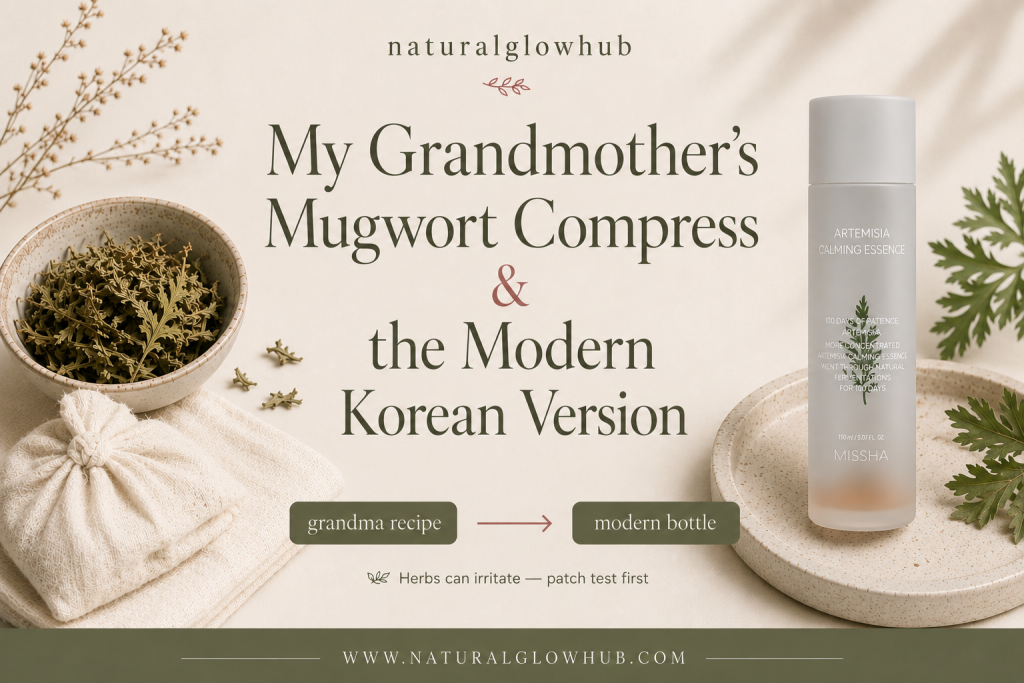
Some herbs feel “new” simply because a brand just put them on a label — when really, your grandmother knew them all along. Mugwort (artemisia) is exactly that kind of case. In Asia it’s been used for generations to calm irritated skin, and in plenty of other traditions dried mugwort sat in a jar for compresses and infusions. I remember a jar exactly like that.
Today Korean brands have taken the same herb and put it into little bottles with the word “artemisia” on the front. So I wanted to look at both: the simple homemade compress, and the bottled version for the days you don’t feel like bothering.
What mugwort is, and why it’s used on skin
Mugwort is a plant in the Asteraceae family — the same one that includes chamomile and ragweed. It contains antioxidants and compounds that have given it a long-standing reputation for being calming — many people find it pleasant on red, reactive, or simply tired-looking skin.
It’s important to say what it isn’t. Mugwort doesn’t “cure” skin conditions, and it’s not a replacement for barrier care or sunscreen. It’s a gentle, soothing step — nothing more. Go in with realistic expectations.
The simple calming compress (the grandmother way)
This is the easiest version — basically brewing a herbal tea for your face:
You’ll need:
- 1–2 teaspoons of dried mugwort (or 1 plain mugwort tea bag)
- 1 cup of hot filtered water
- a clean soft cloth or cotton pads
- a strainer and a clean container
Steps:
- Pour the hot water over the mugwort, let it steep for 10–15 minutes, then strain.
- Let the liquid cool completely to lukewarm or cool — never warm on your face.
- Soak the cloth, wring it lightly, and lay it over clean skin for 5–10 minutes. Or gently press it on with a cotton pad.
- Let it dry, then follow with your moisturizer.
How long it keeps: with no preservatives, the infusion spoils quickly — keep it in the fridge and use it within 2–3 days. Smell it before each use; if in doubt, toss it and make a fresh batch.
Important cautions (read before you try)
Natural doesn’t mean “safe for everyone.” Mugwort deserves a little more care than the other recipes:
- Allergies. If you react to ragweed, chamomile, or plants in the Asteraceae family, there’s a risk of cross-reaction. Skip it, or ask your doctor.
- Patch test — non-negotiable. Apply a little to your arm or behind your ear and wait 24 hours before putting it on your face.
- Pregnancy. Mugwort is traditionally avoided during pregnancy. Even for topical use, check with a professional first if you’re pregnant or breastfeeding.
- Not on broken skin, and stop immediately if you feel stinging, redness, or discomfort.
Why Korean brands bottle artemisia
The homemade compress is lovely, but it has downsides: it only keeps for a few days, the strength varies a little each time, and it takes prep. That’s where the modern version comes in.
Korean brands take artemisia extract and formulate it into stable, consistently dosed essences and ampoules — shelf-stable, hygienic, and the same result every time. It’s the same herb, just “tamed” into a product you can use every night without brewing anything.
For lazy days: the bottled version
Here’s an honest clarification: I haven’t personally tested the specific bottle, so I’m sharing this as a general recommendation, not my own experience. MISSHA has a popular artemisia (mugwort) line — an essence/ampoule aimed specifically at calming sensitive, reactive skin. People like it for its simple feel and its focus on a single herb.
If you decide to try it, the same rules apply as with anything new: check the ingredient list (some artemisia formulas also contain fragrance — if your skin is reactive, look for a version without), do a patch test, and introduce it on its own before combining it with other products.
I will definitely test it!
👉 MISSHA Artemisia Calming K-Beauty Kit
👉 One bottle: MISSHA Artemisia Calming Essence
The bottom line
Mugwort is a nice example of how “old” and “new” are really the same thing — my grandmother knew it as a compress, Korean brands know it as an essence. Both are gentle, soothing steps, as long as you go in carefully: realistic expectations, a clean container, a patch test, and respect for the fact that it’s an herb.
If your skin barrier is irritated and you want to calm it down before adding anything new — I made a free Skin Barrier Recovery Cheat Sheet with the 5-day reset that helped me. 👈
I share this from personal interest and research — I’m not a medical or skincare professional. Mugwort is an herb and may cause a reaction; patch test, avoid it if you’re allergic to Asteraceae plants or pregnant without consulting someone, and see a dermatologist for serious concerns. Everyone’s skin is different.