
July 1, 2026;5 min. read time
Disclosure: This post may contain affiliate links. As an Amazon Associate I earn from qualifying purchases. I may receive a small commission, at no additional cost to you.Full details on my Disclaimer page.
Essence, serum, ampoule, essence-serum, toner-essence… You stand in front of the shelf and every bottle sounds like something you absolutely need. I went through exactly that moment — buying several “steps” at once because I didn’t understand what each one did. So let me make it simple: the difference between an essence and a serum, the order you apply them in, and — the most honest question — whether you even need both.
What an essence is (the Korean approach)
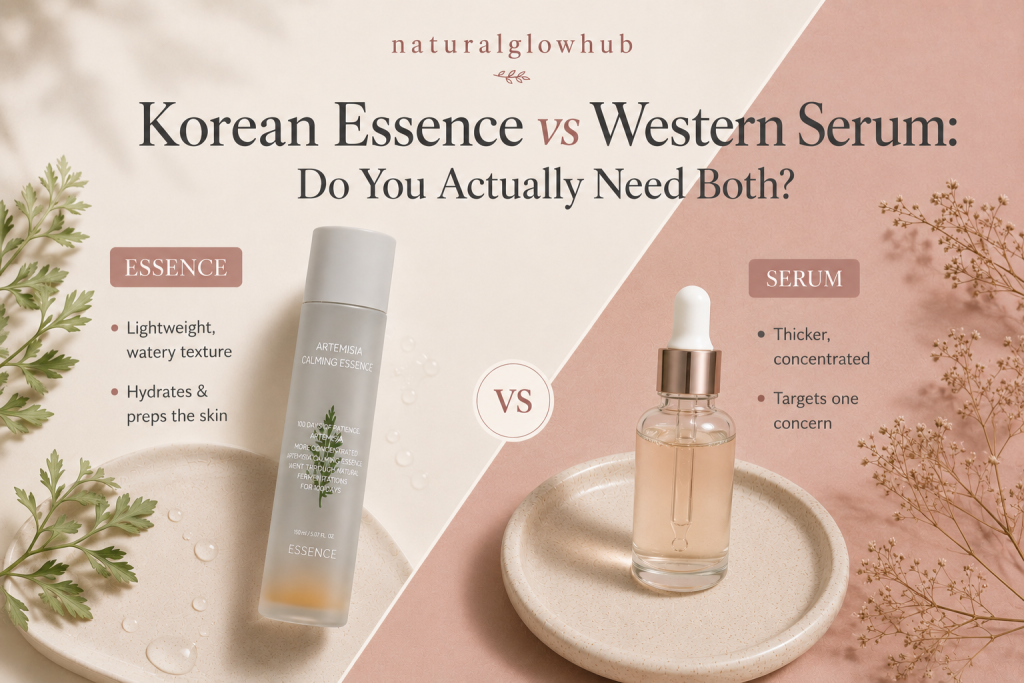
The essence comes from the Korean approach to skincare, and it’s essentially a lightweight, watery step for hydration and prep. It goes on right after cleansing (and after toner, if you use one), and its job isn’t to “treat” one specific problem — it’s to give the skin water and get it ready for the steps that follow.
Many essences are built on humectants (ingredients that draw in water) and on fermented components. The texture is usually like water or a very light gel — it sinks in fast without feeling heavy. If your skin is dry, dehydrated, or just “tired,” the essence is the step that brings comfort back.
What a serum is (the Western approach)
A serum, in the classic Western sense, is a concentrated product aimed at one specific concern. It’s usually built around a single “hero” active:
- vitamin C — for brightening and antioxidant defense;
- niacinamide — for the barrier, oil, and uneven tone;
- retinol/retinoids — for texture and signs of aging;
- salicylic acid — for congested pores.
The texture is often a little thicker, it’s used by the drop, and the idea is “less, but more targeted.” A serum isn’t for hydration in itself — it’s for a target.
One important clarification: the line between the two is blurry. Korean brands make serums and ampoules too; Western brands make essences. So don’t focus so much on the word on the label as on what the product actually does — does it hydrate (essence logic) or target (serum logic)?
The order of application
If you decide to use both, the rule is simple — thinnest to thickest:
- Cleanse
- Toner (optional)
- Essence (hydration/prep)
- Serum (targeted active)
- Moisturizer
- SPF (mornings, non-negotiable)
Essence always before serum — it preps, the serum works, the moisturizer seals it in.
Do you actually need both?
Here’s the honest answer, especially if — like me — you lean toward minimalism and a healthy barrier: usually not.
- If your main goal is hydration and calm skin → a good essence (or even just the right moisturizer) is often plenty.
- If you have a specific concern (dark spots, texture, congestion) → one serum with one active does the job.
- Stacking both every day is rarely necessary — and on an irritated or damaged barrier, it can even be too much.
My approach is: at most one hydrating step and one targeted step, introduced slowly and separately. If you’re unsure — hydration plus SPF beats a shelf of actives. Fewer products applied consistently almost always beat more products thrown on at once.
When does using both make sense? If your skin is stable, not reactive, and you have a clear goal — for example, an essence for morning hydration plus a vitamin C serum for brightening. But that’s an upgrade, not a starting point.
Examples
Essence (an example): a popular, clean option is the fermented MISSHA Artemisia Calming Essence — lightweight, fragrance-free, a good first hydration step. (I haven’t personally tested it — I’m sharing it as a frequently recommended example; check the ingredient list and patch test.)
👉 MISSHA Artemisia Calming Essence
Serum (an example, by ingredient, not by brand): pick one target —
- want brightening → a vitamin C serum;
- want barrier/oil support → niacinamide;
- want texture → a low-percentage retinol (introduced slowly).
I deliberately give serums by ingredient rather than by a specific Western brand — what matters is the active and the concentration, not the logo. (That’s exactly what I dig into in my article on reading labels.)
My minimalist take
The industry wins when you think you need one more step. But skin rarely needs more bottles — it needs consistency and time. If you’re just starting: one hydrating step, one moisturizer, SPF. You add a serum only when you have a clear, specific concern — and one at a time.
If your barrier is irritated right now and you want to calm it first, before adding actives — I made a free Skin Barrier Recovery Cheat Sheet with the 5-day reset that helped me.
A quick note: I’m not a dermatologist. I share from personal experience and research. Everyone’s skin is different — patch test, and see a professional for serious concerns.