
July 20, 2026;6 min. read time
Disclosure: This post may contain affiliate links. As an Amazon Associate I earn from qualifying purchases. I may receive a small commission, at no additional cost to you.Full details on my Disclaimer page.
I’m not a dermatologist or a medical professional. And the honest note for this article: I have one snail product in my daily routine (an eye cream — more on it below), but I haven’t tested the viral essences and masks — for those, I’m speaking from research, not personal experience.
If you’ve spent more than five minutes in the K-beauty space, you’ve already seen it: the clear, stretchy drop on a glass spatula. Snail mucin is possibly the most hyped ingredient in Korean skincare — “glass skin in a jar,” “overnight repair,” “the holy grail.”
But here’s what most viral videos don’t know: for me, this ingredient isn’t a new trend at all.
My Grandmothers Knew It Before TikTok
I grew up in Bulgaria — and here, snail extract creams have been sold for decades, long before K-beauty made them trendy. This isn’t an exotic import from Seoul; it’s something that sits on Bulgarian pharmacy shelves and in grandmothers’ cabinets. Our folk tradition knows the snail beyond cosmetics too — snail syrup is a classic every Bulgarian woman has heard of. (I’m not going to recommend you drink anything — I’m not a medical professional. I’m only saying the tradition runs deep, and it wasn’t invented yesterday by a marketing department.)
When an ingredient survives generations of folk practice AND shows up independently in Korean skincare — to me, that’s a signal it deserves a serious look. So I did what I always do: I set the viral promises aside and went to see what the research says — and what my own face says.
What Snail Mucin Actually Is
Snail mucin (on the label: snail secretion filtrate, or SSF) is the filtered secretion of garden snails. It contains a mix of glycoproteins, hyaluronic-acid-like molecules, trace glycolic acid, zinc, and peptides. On paper — a cocktail of hydrating, skin-supporting components.
Korean skincare has used it for years, usually at concentrations of 70 to 97% in essences, serums, and overnight masks.
The Claims
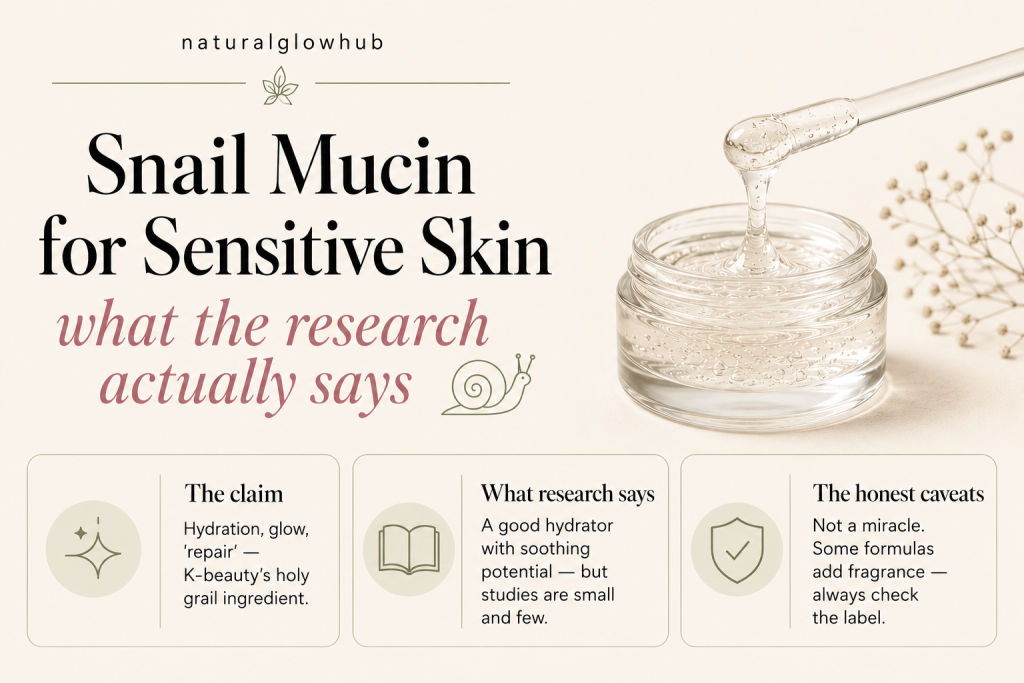
The marketing credits it with three big things: deep hydration, a “glow” effect, and skin repair — from acne marks to fine lines. That trio is exactly what made it go viral.
What the Research Actually Says
This is where I become the boring one at the party — but that’s what you’re here for:
Hydration — yes, with good confidence. The composition (glycoproteins + HA-like molecules) makes it a logical humectant, and the few clinical tests that exist show improved skin hydration with regular use. As a light hydrating layer — it makes sense.
Soothing and support — promising, but not firmly proven. There’s lab (in vitro) data on fibroblast stimulation and healing, and small studies on irritated skin. Sounds good — but “small studies” is the key phrase. Most have few participants, short durations, or sponsors.
“Repairing” scars, wrinkles, acne — here, the science is still catching up. There are no large, independent, long-term studies confirming those promises. Which doesn’t mean generations of experience are lying — it means nobody has bothered to prove it properly yet. That difference matters.
The short version: research confirms the hydration, hints at the soothing, and for the rest — tradition and experience are walking ahead of the science. I personally believe there’s more to it — but I owe you the honest line between what’s proven and what’s my belief.
Who It Makes Sense For (and Who It Doesn’t)
It’s worth considering if: your skin is dry or dehydrated and you want a light, non-sticky hydrating layer; you like minimalist textures; and you’re K-beauty-curious without wanting a 10-step routine.
Approach carefully if: you have a mollusk allergy (snails are mollusks — that’s not a joke, it’s real allergen exposure); your skin is in an active flare-up (reset first, new ingredients later — see here ; or you’re expecting results on deep scars and wrinkles — you’ll be disappointed there.
And as always with a new ingredient: patch test, 48 hours, one new thing at a time.
My Real Experience With the Ingredient
The snail product that actually lives in my routine is the COSRX Advanced Snail Peptide Eye Cream — step 2 of my 4-product evening routine [link to my Article, where it has an active link]. And it would be dishonest to play neutral here: I’m genuinely happy with it. It’s gentle, it hydrates the delicate eye area without a hint of irritation, it’s fragrance-free, and it’s one of the few products that survived my great declutter. It’s one of the reasons I believe in this ingredient instead of just reading about it.
The one nuance I owe you: the formula combines snail mucin with peptides, so I can’t laboratory-separate which one contributes what. But “a snail mucin product that has lasted months in the routine of someone with sensitive skin” is my kind of evidence.
The Honest Caveats
- It’s not a miracle. If someone promises you “overnight repair” — that’s marketing, not biology.
- The formula decides more than the ingredient. 96% SSF on the label means nothing if the remaining 4% includes fragrance that irritates exactly the sensitive skin you bought it for.
- Check for added fragrance. The irony of this category: products marketed for sensitive skin often come with fragrance. An example from my own MISSHA research [see below].
- The ethical question exists. Brands say collection is stress-free for the snails. Transparency varies — if this matters to you, ask before you buy.
If You Decide to Try It: The Bottled Option
From the MISSHA range I covered in my honest roundup [HERE], the snail option is the [MISSHA Cell Renew Snail Sleeping Mask] — an overnight mask with a snail mucin complex.
The honest note, same as in the roundup: this is a general recommendation, not personal experience — I haven’t tested it. And the flag I already gave there: this formula contains fragrance — if your skin is reactive, the patch test isn’t optional here, it’s mandatory. If fragrance is a dealbreaker for you, look for a fragrance-free SSF essence with a short ingredient list.
The Bottom Line
I’m in the believer camp — with my grandmother’s tradition behind me, the hydration research, and my own eye cream as evidence. But I’m a believer with open eyes: buy the ingredient, not the hype. Look at the whole formula, check for fragrance, and expect the real thing (calm, hydrated skin), not the viral thing (“new skin overnight”). That way the ingredient gets a chance to make you happy instead of letting you down.
And if your skin is irritated and reactive right now — before any new ingredient, strip things back and let it settle. That’s exactly what my free 5-day reset plan is for:
→ [Get the free Skin Barrier Recovery Cheat Sheet here]
This is what I found in my research and my own experience — everyone’s skin is different, and I’m not a medical professional. If you have persistent skin concerns, please talk to a dermatologist.