
Disclosure: This post may contain affiliate links. As an Amazon Associate I earn from qualifying purchases. I may receive a small commission, at no additional cost to you.Full details on my Disclaimer page.
By Marina / June 29, 2026;5 min. read time
Long before Sephora and 10-step routines existed, women cared for their skin with whatever was in the kitchen. Rice water — the cloudy liquid left after rinsing or cooking rice — is one of the oldest of those ingredients in Asia. In Japanese, Korean, and Chinese traditions it was used for generations, long before anyone called it “skincare.”
K-beauty still leans on the same idea today. A lot of popular Korean essences are built on fermented ingredients — and fermented rice water is the original, homemade version of that principle. So I wanted to look at both: how to make the toner at home, and what the easy bottled alternative is for the days you don’t feel like bothering.
Why rice water at all?
Rice water contains amino acids, small amounts of B vitamins, starch, and antioxidants (including ferulic acid). Because of that, many people find it light, soothing, and slightly smoothing — a toner that hydrates without feeling heavy.
It’s important to say what it isn’t. Rice water is not a miracle fix and it doesn’t “cure” anything. It won’t replace your moisturizer, and it definitely won’t replace your sunscreen. It’s a simple, gentle step — nothing more, nothing less. If anyone promises you a transformation from a single kitchen ingredient, stay skeptical.
The simple recipe (to start)
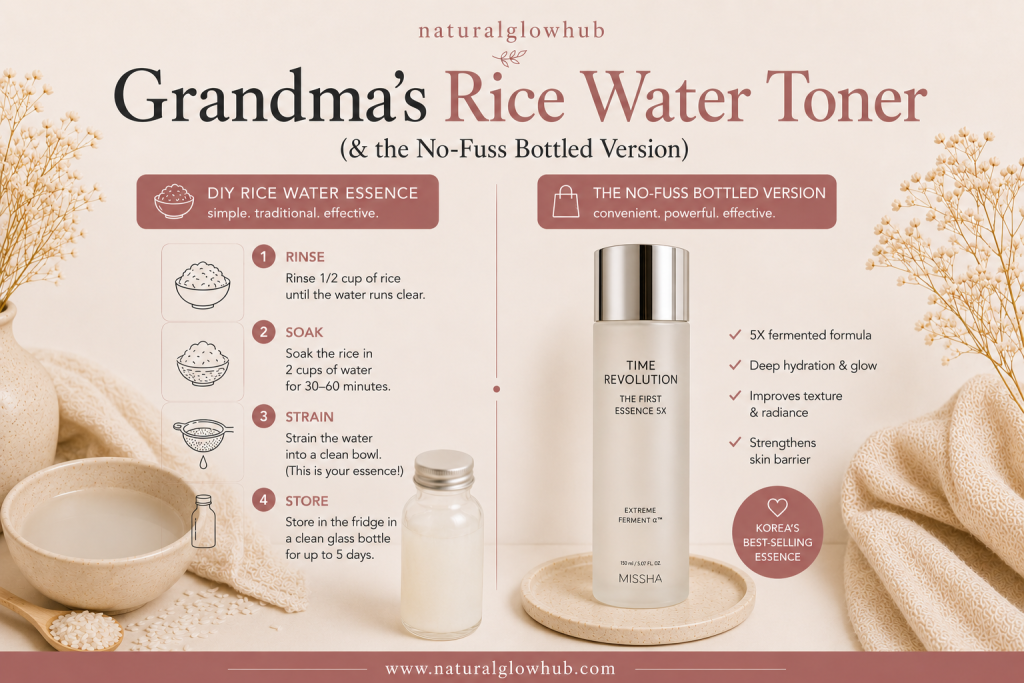
This is the easiest, non-fermented version — a good first try:
You’ll need:
- 2–3 tablespoons of white rice
- 1 cup of filtered water or just water
- a strainer and a clean glass jar
Steps:
- Rinse the rice twise to wash off any dust, and pour that water out.
- Cover the rice with the cup of filtered water and let it soak for 30–60 minutes.
- Strain it. The cloudy water that’s left is your toner.
How to use it: after cleansing, apply a little with a cotton pad or mist it on lightly, let it absorb for a few seconds, then follow with your moisturizer. To start, 2–3 times a week is plenty — see how your skin responds before doing it more often.
How long it keeps: since there are no preservatives, rice water spoils quickly. Keep it in the fridge and use it within 3–5 days. Smell it before each use — if it smells off, toss it and make a fresh batch.
The fermented version (closer to the K-beauty idea)
If you want to get closer to the principle behind Korean essences, you can let the rice water ferment. After you strain it, leave it in a clean, covered container at room temperature for 24–48 hours, until it starts to turn slightly sour and smells faintly like a mild leaven. Then move it to the fridge and use it within a few days.
Fermentation is thought to make some of the ingredients more available to the skin. But hygiene matters even more here:
- Use a completely clean jar.
- Fermentation is not the same as spoilage. A faintly sour smell is fine; a rotten smell, sliminess, or any sign of mold means “throw it out immediately.”
- Do a patch test on your arm or behind your ear 24 hours before putting it on your face — especially with the fermented version.
Who it might not suit
Natural doesn’t mean “for everyone.” Be careful, or skip it, if you:
- have very sensitive, allergy-prone, or reactive skin;
- have active inflammation, eczema, or broken skin — don’t apply it over that;
- feel any stinging, tightness, or redness — stop and rinse.
Some people notice a slightly drying effect from the starch with frequent use. Listen to your skin — it sets the pace, not an internet trend.
For lazy days: the bottled alternative
I’ll be honest — making rice water is a bit of a hassle. It only keeps for a few days, it smells, and it takes prep and regular remaking. For the days you simply don’t feel like it, a bottled fermented essence gives you that same “ferment on the skin” idea, but in a shelf-stable, tested, and hygienic form.
Here’s an honest clarification: not all fermented essences are rice-based. One of the most loved — MISSHA Time Revolution The First Essence 5X — is built on yeast ferment, not rice. A different ferment, but the same principle: fermented active ingredients, light hydration, and a clean formula.
I haven’t tested it myself, so I’m sharing this as a general recommendation, not as my own experience. What makes it a popular choice is its simple, clean formula and light texture — many people with sensitive skin like it and use it as a “first essence” step right after cleansing. The reviews are consistently good. If you decide to try it, the same rule applies as with anything new: patch test first, and introduce it on its own before combining it with other products.
👉 MISSHA Time Revolution The First Essence 5X — link here
The bottom line
Rice water is a nice, inexpensive way to experience a tradition older than the entire beauty industry — as long as you go in with realistic expectations and a clean jar. And if you don’t have time for kitchen chemistry, a bottled fermented essence does the same job with less fuss. Either way, the idea is the same: gentle, simple, no hype.
If your skin barrier is irritated and you want to calm it down before adding anything new 👉 I made a free Skin Barrier Recovery Cheat Sheet with the 5-day reset that helped me.
Quick disclaimer: I am not a dermatologist or medical professional. I share this out of personal interest in natural skincare and research. Everyone’s skin is different — always do a patch test and consult a dermatologist for serious concerns.